- partheyehospitals@gmail.com
- +91 7011570116

Glaucoma
What Is Glaucoma?
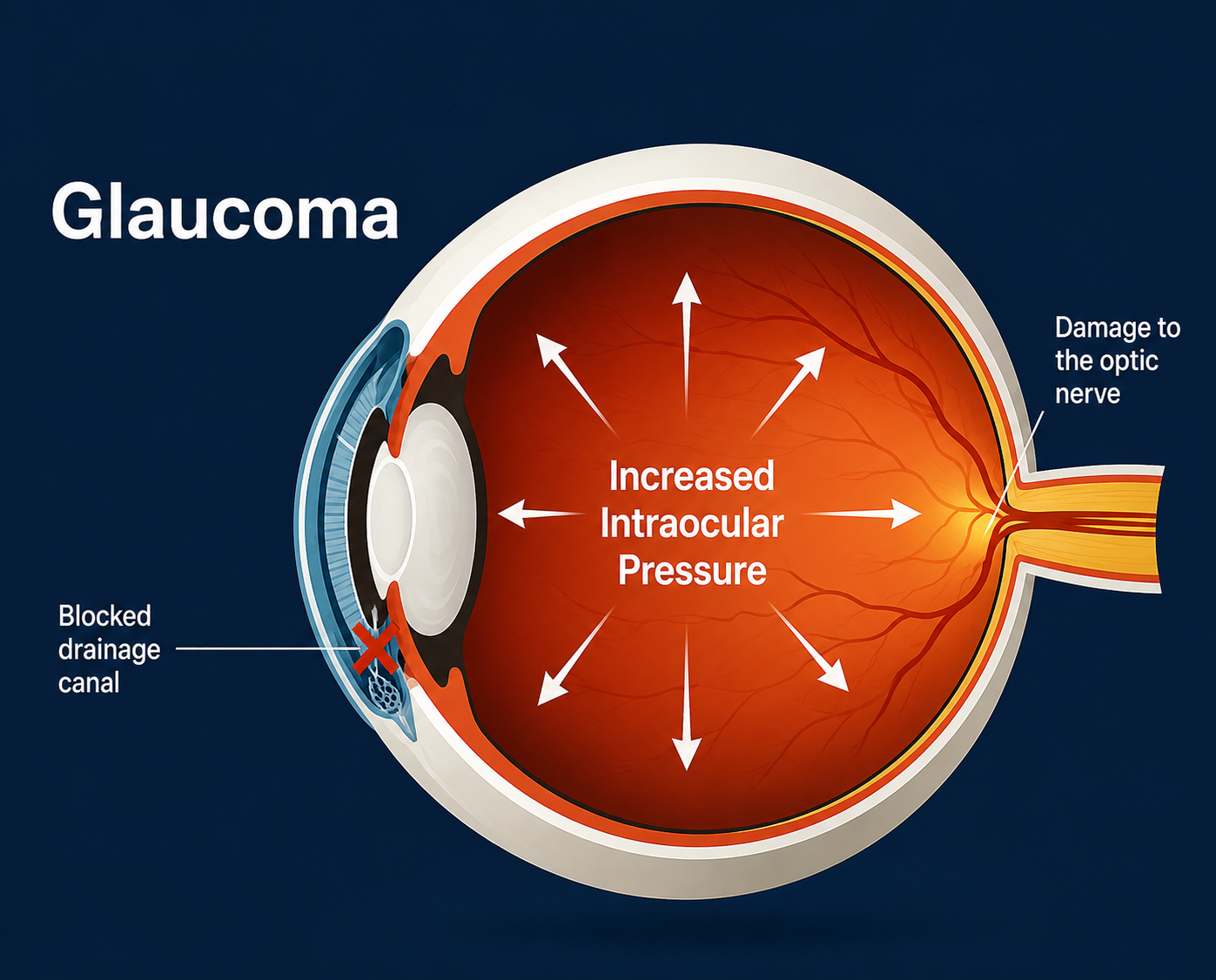
Glaucoma, is a group of eye conditions that cause damage to the optic nerve, the crucial bundle of nerve fibres that transmits visual information from the eye to the brain. This damage is most often linked to abnormally high pressure inside the eye, known as Intraocular Pressure (IOP). The eye constantly produces a fluid called aqueous humour, and when the drainage system for this fluid becomes blocked or inefficient, pressure builds up. Over time, this elevated pressure pushes on and damages the delicate optic nerve, leading to irreversible vision loss, typically starting with peripheral (side) vision. Because the initial vision loss is usually gradual and painless, glaucoma is often called the “silent thief of sight.”
Right Diagonsis
Correct diagnosis is starting point of any treatment
Latest Technology
Globally trusted and clinically proven systems
Expert Doctors
Highly experienced and results-driven specialists
Timely Followup
Timely followup and management
01.
Types Of Glaucoma
The condition is broadly categorized based on the drainage angle of the eye:- Primary Open-Angle Glaucoma (POAG) : The most common form. The drainage angle is open, but the eye’s internal meshwork (trabecular meshwork) clogs up over time, leading to slow, gradual pressure build-up.
- Angle-Closure Glaucoma (Acute/Chronic) : Occurs when the iris (the coloured part of the eye) bulges forward and physically blocks the drainage angle, causing a rapid and often painful increase in eye pressure (Acute Angle-Closure is a medical emergency).
- Normal-Tension Glaucoma (NTG) : Occurs when the iris (the coloured part of the eye) bulges forward and physically blocks the drainage angle, causing a rapid and often painful increase in eye pressure (Acute Angle-Closure is a medical emergency).
- Secondary Glaucoma : Glaucoma that develops as a result of another medical condition, eye injury, inflammation (uveitis), advanced cataract, or prolonged use of steroid medications.
02.
Symptoms Of Glaucoma
Symptoms vary significantly depending on the type of glaucoma:
- Gradual (Open-Angle Glaucoma – Most Common) – Symptoms are slow to develop and often unnoticed until significant, irreversible vision loss has occurred.
- Acute (Angle-Closure Glaucoma – Emergency) – Most Common) – Symptoms are sudden, severe, and require immediate medical attention.
- Painless Loss of Peripheral (Side) Vision – (Most Common) – This is the most common sign of the slowly progressing Open-Angle Glaucoma. The visual field gradually narrows, often leading to “Tunnel Vision” before central sight is affected.
- No Symptoms in Early Stages – Many people with the most common form have no awareness of the disease until it is advanced.
- Sudden, Severe Eye Pain – A hallmark of the acute (Angle-Closure) form.
- Blurred or “Steamy” Vision – Sudden haziness or cloudiness in vision, often seen in the acute form.
- Nausea and Vomiting – Systemic symptoms that can accompany the sudden, severe eye pain of acute Angle-Closure Glaucoma.
- Eye Redness – Significant redness of the eye, typically only seen in the acute form.
03.
Who Can Get Glaucoma?
While anyone can develop glaucoma, the risk is significantly higher in certain groups:
- Age : Individuals over the age of 60.
- Family History : Having a parent or sibling with glaucoma significantly increases the risk.
- High Intraocular Pressure (IOP) : Elevated pressure is the primary risk factor.
- Medical Conditions : Chronic diseases such as Diabetes, High Blood Pressure, and certain heart conditions.
- Long-term Medication Use : Prolonged use of steroid medications, especially steroid eye drops.
- Eye Characteristics : Severe nearsightedness (myopia), farsightedness (hyperopia), or thin corneas.
Glaucoma Management At Parth Eye Hospital
Paarth Eye Hospital offers a dedicated Glaucoma clinic equipped with state-of-the-art diagnostic and treatment technology to detect and manage the disease:OCT FUNDUS Imaging
- We use Optical Coherence Tomography (OCT) to capture high-resolution, cross-sectional images of the optic nerve head and the Retinal Nerve Fiber Layer (RNFL). This technology allows for the precise measurement of nerve damage and tracking of disease progression over time, often detecting changes earlier than traditional methods.
Perimetry Machine (Visual Field Test)
- The Perimetry Machine is used for functional assessment, creating a map of the patient's entire field of vision. This test identifies and quantifies any loss of peripheral vision, which is a hallmark of glaucoma, to monitor the effectiveness of treatment.
YAG Laser Iridotomy
- A quick, non-invasive laser procedure performed using the YAG Laser to create a tiny opening in the iris. This is the primary treatment for Angle-Closure Glaucoma, relieving the blockage and allowing the fluid to drain efficiently, thereby lowering eye pressure.
Medical Management (Eye Drops)
- Prescribing specialized eye drops that either decrease the production of fluid in the eye or increase its outflow to reduce Intraocular Pressure (IOP).
Conventional Glaucoma Surgery
- Performing surgical procedures like Trabeculectomy to create a new, bypass drainage channel for the eye fluid when medical and laser treatments are insufficient to control the pressure.